My Commercial Pilot Checkride: Oral and Flight Review
Intro
Every question in the oral came back to one scenario: a friend hires me to fly his airplane to a birthday party.
- This is a review of my Commercial Pilot checkride in a PA-28-161 (Piper Warrior II): the questions the DPE asked, how I answered, and how the flight went.
- The oral ran about 2.5 hours, and every question was a follow-up on the cross-country scenario.
- The answers are what I said during the exam, not necessarily the correct ones. Where something needed correcting, I added a note.
- For a keyword review of the oral topics, see my Commercial Pilot Checkride Oral Cheat Sheet. For my earlier checkrides, see the PPL and IR reviews.
⚠️ Every DPE is different. This is one checkride, one day, one examiner. Always prepare from the Commercial Pilot ACS.
The Cross-Country Scenario
- A friend who owns a single-engine land airplane hired me as the pilot.
- A birthday party at the destination, departing at 12 PM.
- The destination is 171 NM from the departure airport.
- Passengers: my friend and one other person, so 3 people including me.
- No weight-and-balance twists like needing a fuel stop or moving passengers to fix the CG.
- I wrote separate weight-and-balance calculations for the scenario and for the actual flight.
1. Oral
- About 2.5 hours, roughly 09:50–13:20.
- Every question was a follow-up based on the scenario.
1.1 Regulations
-
The DPE pointed to 61.129(a)(3)(i):
Ten hours of instrument training using a view-limiting device including attitude instrument flying, partial panel skills, recovery from unusual flight attitudes, and intercepting and tracking navigational systems.
He said having an instrument rating doesn’t automatically mean you meet the partial panel and unusual attitude parts. He had me go through my logbook, show which flights covered those items, and add them up to 10 hours. This can take a while if you’re not ready, so add it up ahead of time.
- Required documents?
- Pilot certificate, photo ID, medical certificate.
- What class of medical do you hold?
- When did you get it?
- When does it expire?
- He didn’t want “12 calendar months.” He wanted the exact date my 1st class privileges expired.
- Issued June 13, 2024 (I was under 40) → 1st class privileges through June 30, 2025.
- From July 2025, it’s valid only for 3rd class privileges.
- If you pass today, can you fly commercially right away?
- No. I’d need at least a 2nd class medical.
- Then how can you take the commercial checkride today?
- A 3rd class medical is enough for the checkride itself.
- (Scenario) If you pass today, can you fly for compensation?
- What is “holding out”?
- (Scenario) The owner came to you and asked you to fly his airplane. Is that legal?
- Yes.
- What if you bought your own airplane and offered pilot services?
- I’d need an operating certificate.
- (Scenario) Who has operational control of this flight?
- (Scenario) What currency do you need to fly today? List everything.
- Flight review, and 3 takeoffs and landings within the preceding 90 days to carry passengers (full stop for tailwheel or night).
- When was your flight review?
- My IR checkride last September counts in place of a flight review.
- Are you night current?
- No.
- This is a day VFR flight, but what if plans change and you need to fly back at night with passengers?
- Do 3 takeoffs and landings at the destination first, without passengers.
- Note: 61.57(b): 3 takeoffs and 3 landings to a full stop, as the sole manipulator of the controls, in the same category, class, and type.
- When exactly?
- From 1 hour after sunset to 1 hour before sunrise.
- The red position light is broken. Can you still make this flight?
- Yes. It’s not required for day VFR.
- Where does it say that?
- What about at night?
- Can’t fly. It has to be fixed.
- Can you replace the position light yourself?
- Yes. It’s preventive maintenance, and I hold at least a private pilot certificate.
- Appendix A to Part 43, (c)
- Note: under 43.3(g), a pilot may do preventive maintenance only on an aircraft the pilot owns or operates (not used under Part 121, 129, or 135), and it must be logged per 43.9.
- You want to fly back at night, but the person who hired you shows up drunk. What do you do?
- I said something about a breathalyzer, but that didn’t seem to be what he was looking for, so I changed direction.
- I’d assess his condition myself. You can tell when someone is heavily intoxicated without a breathalyzer.
- If he’s in bad shape, as PIC I have the authority to deny boarding.
- What’s the legal limit for alcohol?
- 0.04 BAC, and 8 hours bottle-to-throttle.
- What illusions are common at night?
- False horizon, autokinesis.
- Explain both.
- How do you deal with them?
- Trust your instruments.
- For autokinesis, don’t stare at a single point for too long.
- How do you dark-adapt your eyes?
- Avoid bright white light and use red lighting.
- How long does it take?
- About 30 minutes.
- Currency vs proficiency?
- Do you consider yourself proficient enough for this flight?
- Yes.
- (Scenario) Flying your friend’s airplane, what documents do you need to check?
- ARROW.
- I mentioned the airworthiness certificate, registration, POH, and weight and balance.
- I intentionally left out the radio station license since this wasn’t an international flight. (I was curious whether he’d ask about it, but he didn’t.)
- Do you have copies of the airworthiness certificate and registration?
- No. (It’s a good idea to at least take a photo of them when you prepare for the checkride.)
- “Okay, point them out to me during the preflight.” (He did check later.)
- When do the airworthiness certificate and registration expire?
- Airworthiness certificate: doesn’t expire as long as the airplane is maintained per the regulations.
- Registration: 7 years.
- What inspections are required to keep this airplane airworthy?
- AVIATES.
- Went through AVIATES one by one in the maintenance logbook: when each inspection was done and exactly when it expires.
- What is an Airworthiness Directive?
- Does this airplane need a 100-hour inspection for this flight?
- No.
- The key is whether the pilot is for hire or the airplane is for hire.
- Side note: if the airplane is for hire, it needs 100-hour inspections and a landing light. A privately owned airplane doesn’t need 100-hour inspections, and no landing light is required even at night.
- What if the airplane needs to fly somewhere to be inspected?
- Special flight permit (ferry permit).
- How do you get one?
- Through the FSDO.
- Which instruments use the pitot-static system?
- Airspeed indicator, altimeter, VSI.
- What would make you suspect something is wrong with the airspeed indicator? (Something like that. I don’t remember the exact wording.)
- If the pitot tube were blocked, the airspeed indicator would read zero (with the drain hole also blocked, it acts like an altimeter instead), but he didn’t say it read zero, so I figured that wasn’t the scenario.
- I said I’d suspect a blocked static port.
- I may have been overthinking it, but based on what followed, my answer wasn’t wrong.
- If the static port is blocked, what do you do?
- Pull the alternate static source knob.
- How does the alternate static source affect the instruments?
- Venturi effect → faster air → lower pressure → airspeed reads high, altimeter reads high, VSI shows a momentary climb.
- Besides what the maintenance logbook shows for the ELT inspection, is there anything else to check?
- Battery replacement: after 1 hour of cumulative use, or 50% of its useful life (91.207(c)).
- What is a Supplemental Type Certificate (STC)?
- Can you give an example?
- A sun visor.
1.2 Flight Plan (ForeFlight & Navlog)
- What do you use for the weather briefing?
- ForeFlight.
- What else could you use?
- Leidos 1800wxbrief.
- Can you still get weather in flight?
- FSS on 122.2.
- Any other way?
- FIS-B. It receives weather over ADS-B and shows it in ForeFlight. I find it really useful.
- How else can you contact FSS besides 122.2?
- By phone.
- What’s the number?
- I had it saved from my PPL days and pulled it up on my phone.
- Have you actually called them?
- During PPL training I called before every cross-country. Over time I noticed they were telling me what I was already seeing, so I figured if I could read the weather correctly myself, it wasn’t necessary every time. I added that it’s still a good idea to cross-check with them occasionally.
- So what’s the bottom line? Go or no-go today?
- No-go. The part of the route near the destination is IFR.
- How did you decide?
- Walked through my personal minimums (including PAVE and IMSAFE).
- You’ve been prescribed a medication. How would you decide whether it’s safe to fly?
- Walk me through your flight plan.
- Cruising altitude: my personal minimum of MEF + 500, following the VFR cruising altitude rules.
- I wanted to avoid mountainous terrain.
- The route was planned for pilotage (assuming no GPS). Even if the route zigzags, I chose checkpoints that are easy to spot from a distance and easy to fly over precisely.
- Direct at 4,500 ft: one section has an MEF of 4,200 ft, which doesn’t meet my personal minimum → ruled out.
- Direct at 6,500 ft: 171 NM / 11 gal / ETE 1h26m / 17 kt tailwind.
- Zigzag at 4,500 ft: 185 NM / 12 gal / ETE 1h30m / 19 kt tailwind.
- I chose the zigzag at 4,500 ft. It uses 1 more gallon and takes 4 more minutes, but greatly reduces the chance of getting off course.
- How did you get the temperature at cruising altitude?
- Winds aloft forecast.
- How much did it change between yesterday’s navlog and today’s briefing?
- About 1 degree, pretty negligible.
- How did you calculate TAS?
- POH 5-22, Best Power Cruise Performance, 65%.
- How did you calculate fuel burn?
- Same chart: 8.8 GPH, applied to the groundspeed and leg distances.
- Did you account for fuel beyond the flying?
- Yes. I added 2.0 gallons for ground operations.
- Explain the fuel system.
- I explained it generally, then asked if I could use the POH diagram. He said “of course,” so I opened it and walked through it.
- What does the throttle do?
- Controls the amount of fuel-air mixture going into the cylinders.
- What does the mixture control do?
- Controls the fuel-to-air ratio.
- Did you pick an alternate?
- The flight was a no-go, but I picked one just in case.
- A warm front was moving up from the southwest, so I picked an airport about 40 NM northeast of the destination.
- Give me a general weather overview using your ForeFlight briefing.
- Walked through the prog chart (pressure systems, isobars, precipitation, troughs, fronts).
- Passengers might be uncomfortable with turbulence. What do you check?
- AIRMETs, SIGMETs, convective SIGMETs.
- Why does turbulence form?
- I said orographic, convective, and frontal lifting.
- A cleaner answer would have been thermal (convective), mechanical, frontal, and wind shear.
- What’s the purpose of VA (maneuvering speed)?
- Below VA, the airplane will stall before exceeding its structural load limit.
- How does VA change with weight?
- Lower weight → lower VA.
- What do you check for icing risk?
- Freezing level, AIRMETs, and visible moisture (cloud forecasts).
- If we flew into icing, do we have any de-icing equipment?
- Technically anti-icing, but carb heat, pitot heat, and the windshield defroster can help.
- What is carburetor icing?
- Why does it form?
- Venturi effect.
- Under what conditions?
- 20–70°F, humidity above 80%.
- How do you deal with it?
- Apply carb heat.
- How does carb heat work?
- Air heated by the exhaust, through a shroud around the muffler.
- Why not leave carb heat on all the time?
- The air is less dense and unfiltered, which reduces performance.
- What’s the main risk with the heating system?
- Carbon monoxide poisoning.
- Why and how does it happen?
- A cracked muffler can let exhaust gas into the cabin.
- How do you detect it?
- CO is colorless and odorless. You can’t tell without a detector, like the one on a Sentry.
- Symptoms?
- Exhaust smell, dizziness, headache, blurred vision.
- If a passenger shows symptoms, what do you do?
- Turn off the cabin heat, open the vents and windows, land as soon as possible.
- Open the PIREPs. What is a PIREP?
- Which PIREPs matter most?
- UUA (urgent). Filter out ones far above or below our altitude and ones too far off our route.
- Read the METARs and TAF.
- What is a NOTAM?
- Walk through the departure and destination NOTAMs.
- Any other NOTAMs relevant to this flight?
- I mentioned some en route NOTAMs around BDL:
BDL SVC SSR UNSERVICEABLE 2605212258-2606042359→ secondary surveillance radar (the radar that interrogates transponders)BDL SVC MBST/WS DETECTION SYSTEM NOT AVBL 2605230003-2606302359→ microburst / wind shear detectionBDL SVC TAR UNSERVICEABLE 2605222359-2606302359→ terminal area surveillance radar
- I mentioned some en route NOTAMs around BDL:
- What is a TFR?
- Can you fly through one?
- Common reasons a TFR is issued?
- Where do you find them?
- NOTAMs and the ForeFlight map layer.
- What would you do if a military jet pulled up next to you and started rocking its wings?
- “That’d be really cool.” (We both laughed.)
- But that’s probably not the point, right?
- Yeah, I probably did something wrong.
- So what would you actually do?
- I’d be on flight following, so I’d check with the controller.
- I’d also be monitoring 121.5 and listen for anyone trying to reach me.
- Note: AIM 5-6-13: rocking wings means “you have been intercepted, follow me.” Acknowledge by rocking your wings, follow the interceptor, try to contact them or ATC on 121.5, and squawk 7700 unless told otherwise.
- What’s the weather at the departure airport?
- The TAF hadn’t changed since I prepared my navlog, so I showed the same one.
- Does it meet your personal minimums?
- Yes.
- Takeoff performance?
- 1,200 ft. Showed my calculation.
- Does that look right to you?
- Given the current temperature, pressure, and headwind, it makes sense from my experience.
- Weather at the destination? Which runway would you use?
- Based on the current METAR, runway 14.
- Does it meet your personal minimums?
- Winds were 140@14G23. It meets my personal minimums, though I mentioned it wouldn’t meet my checkride personal minimums.
- Landing performance?
- 540 ft.
- 540 ft? Is that really all you need?
- Probably more than that.
- Look at the chart again. What does 540 ft represent?
- Ground roll.
- Is ground roll all you need?
- No, you also need room for the approach, roundout, and flare.
- So what number should you use?
- Over a 50 ft barrier.
- Recalculate.
- About 950 ft.
- Okay, let’s look at your route on the sectional together.
1.3 VFR Sectional Chart
- He pointed to the departure airport (in Class E starting at 700 AGL).
- What airspace is this?
- Class E.
- Class E weather minimums?
- 3-152 (3 SM, 1,000 above, 500 below, 2,000 horizontal).
- What’s the floor?
- 700 AGL.
- What’s below 700 AGL?
- Class G.
- How high does Class E go?
- Up to 18,000 ft MSL.
- What’s above that?
- Class A.
- So where exactly does Class E end?
- Up to, but not including, 18,000 ft MSL.
- Class G weather minimums (day / night)?
- The airport is shown in magenta. What does that mean?
- Non-towered airport.
- What do the tick marks around the airport symbol mean?
- Fuel available (services available).
- What’s the star just above the airport symbol?
- Rotating beacon (operates from sunset to sunrise).
- Walk through the airport data block.
- Elevation
- L* (lighting limitations exist; pilot-controlled lighting)
- How do you turn on the runway lights?
- Tune the CTAF and key the mic 3, 5, or 7 times for increasing intensity.
- Longest runway length
- CTAF frequency
- What’s the glider symbol?
- Glider operations.
- What’s this symbol (an open circle with an “R”)?
- Private (restricted) airport, non-hard-surface runway.
- Can you land there?
- It’s not a public airport, so not without permission. Emergency use only.
- (Pointing to a Class D airport) What is this?
- Class D weather, equipment, and communication requirements?
- (Pointing to a Class C airport) What is this?
- Class C weather, equipment, and communication requirements?
- (Pointing to a spot mid-route) If the engine fails here, what do you do?
- Best glide (73 kt), look for a flat area, and turn toward it.
- How do you know how far you can glide?
- POH 5-31, Glide Performance.
- From your cruising altitude, how far can you glide?
- The terrain around there is mostly flat, and the nearby airport elevation is around 300 ft.
- From the chart, about 7 NM.
- Is there an airport within range?
- There’s one about 5–7 NM away, but I’d rather land in an open field, because the chart assumes no wind, so the actual glide distance could be different.
- (95 NM into the 185 NM route) You’re diverting for a thunderstorm and the airport is 40 NM away. Can you make it?
- Yes.
- How do you know?
- Calculated groundspeed, ETE, and fuel with my prep chart.
- How far do you need to stay from a thunderstorm?
- 20 NM.
- Okay, you diverted and now the storm has cleared. Ready to go?
- Yes.
- Does your fuel still meet your personal minimums?
- Ran through the numbers: fuel used so far, VFR day reserve (30 min), my personal reserve (30 min), and the alternate fuel I had already used.
- I can make it to the destination without refueling.
- What’s this gray airspace?
- TRSA.
- If you fly through a TRSA, what do you do?
- Radio contact isn’t mandatory, but I’d participate voluntarily.
- What service can you expect in a TRSA?
- Radar service (sequencing and separation).
- What about the area between the TRSA and Class E?
- Class G.
- What’s this magenta dashed line?
- Class E surface area (here, an extension of the Class D).
- Where does it start?
- At the surface.
- What is a hot spot?
1.4 Weight & Balance
- Walked through my weight-and-balance calculation and the CG envelope graph.
- Where is the CG?
- Aft.
- Characteristics of an aft CG?
- How does an aft CG affect takeoff and landing performance compared with a forward CG?
- What is the utility category?
- I blanked on this one.
- Difference between the utility and normal categories?
- I said something about weight… not a great answer.
- Note: the utility category has higher load factor limits (+4.4 / -1.76 g vs +3.8 / -1.52 g for normal) and allows limited aerobatics, usually at a lower maximum weight and with a forward CG limit.
- Where can you find that information?
- POH 2-4, Section 2.17 Flight Load Factors.
- Later he had me find the category on the airworthiness certificate during the preflight.
- If the airplane is in the utility category, can you practice spins?
- No. Our POH explicitly says spins are not approved.
- Do you know how to recover from a spin?
- What causes a spin?
- What causes a stall?
- Difference between a stall and a spin?
- What are the primary flight controls, and what does each do?
- Ailerons (roll), rudder (yaw), stabilator (pitch).
1.5 Other Questions
These came up somewhere in the oral, though I don’t remember the exact context for all of them.
- Supplemental oxygen requirements?
- What is hypoxia? Symptoms? How do you respond?
- What’s the danger of hand-propping an airplane?
- Have you ever had a large mag drop during the run-up? How did you handle it?
- Yes, once.
- My instructor fixed it: lean the mixture, run it up, and burn off the carbon deposits on the spark plugs.
- What if it still drops after that?
- Bad magneto (or spark plug). No-go.
2. Flight
- 1.8 Hobbs (14:00–16:00).
- The air was super smooth, but the surface wind was almost a direct right crosswind at 9–10 kt.
2.1 Before We Started
- I got to choose between chandelle and lazy eight, and between steep turn and steep spiral. I obviously picked chandelle and steep turn.
- During the cross-country portion, Garmin GPS and ForeFlight navigation were off-limits. I could use the ForeFlight sectional, but with own-ship position and breadcrumbs turned off.
- Flight following had to be requested for real (not a mock).
- He said I could hand him the controls if needed.
- Go-arounds were fine, but not when already close to the runway.
- Repeated go-arounds weren’t acceptable without a real safety reason.
- No go-around on the power-off 180.
Preflight
- He asked me to find the airworthiness certificate, registration, POH, and weight and balance.
- He had me find where the category is shown on the airworthiness certificate (following up on the question I fumbled in the oral).
- Oil was about 5.5 quarts. The POH minimum is 2, but our standard is 6–8, so we added oil.
- He pointed to each antenna and had me identify it: COM1, COM2, NAV1, NAV2, transponder, GPS, ADS-B, ELT.
Engine Start
- OAT around 18°C, first flight of the day for the airplane.
- Throttle pump ×2, prime ×2, started right away.
- Not on the checklist, but after start I checked fuel pressure on both the left and right tanks with the boost pump on and off.
Taxi
- Proper wind correction throughout.
- Cleared left and right before every turn.
- Another airplane was parked too close to the taxiway. I called out that I was moving right of the centerline to clear it, then continued.
- Checked the turn coordinator in taxi turns: turning in the right direction, ball moving opposite to the turn.
2.2 Cross-Country (Pilotage)
- I got to choose the takeoff type and went with normal.
- After the on-course checkpoint (3 NM from departure), I requested flight following.
- ATC asked whether I was really going the right way, since my route zigzagged. I said I was practicing pilotage, and they said roger.
- The first checkpoint was 11 NM from the on-course checkpoint. I was about 30 seconds behind my navlog estimate.
- I was setting up for the next leg when he ended the pilotage portion.
- I expected a diversion during pilotage, but it didn’t come. We went straight into maneuvers.
- Canceled flight following before the maneuvers.
2.3 Maneuver Summary
- I tried to keep narrating what I was doing and what was coming next.
- Unless the DPE said otherwise, I always did clearing turns before maneuvers.
- Very smooth air with almost no turbulence, ideal for maneuvers.
- Order of maneuvers: Steep turn → chandelle → slow flight (clean) → power-on stall → power-off stall → accelerated stall → engine fire → engine failure → eights on pylons → diversion → takeoffs & landings
- Takeoff & landing order: Normal landing → soft-field takeoff → soft-field landing → short-field takeoff → short-field landing → normal takeoff → power-off 180
- Takeoffs & landings:
- All at the home airport.
- All landings were full stop, taxi back.
- I got to choose the type, order, and touchdown point.
- The DPE called a go-around on one of my short-field landing attempts.
- The short-field landing required real max braking (he told me when to release).
2.4 Maneuver Details
Steep turns
- Picked my own reference point and rolled into it.
- Left and right back-to-back.
Chandelle
- Got to choose the direction. I picked left.
Slow flight
- Got to choose clean or landing configuration. I chose clean.
- He asked what VS1 was.
- Stabilized at 52–53 kt, level at 4,000 ft. Did a level left turn (about 40 degrees), then recovered.
Stalls
- Power-on, power-off, and accelerated stalls.
Engine fire (right side of the engine)
- Used a do-verify flow: memory items first, then the checklist.
- Left turn, emergency descent.
- Descended from 4,000 ft to 2,800 ft, then recovered.
Engine failure (continued from the fire)
- While I was climbing out of the emergency descent, he went straight into an engine failure.
- Ran the checklist, made the radio call, and headed toward a field I had picked.
- He asked whether I was going to land in that field.
- Something felt off. I went back through the checklist and realized I hadn’t called “door open.” Added it.
- He asked me to be more specific about which field.
- I confirmed I thought we could make it, and he told me to level off at 1,000 ft.
- Continued at 1,000 ft into eights on pylons.
Eights on pylons
- Moved to the pylons I had used in practice.
- While setting up with the pylons on my left and doing a clearing turn for the entry, he asked my pivotal altitude.
- I answered from the table I had prepared.
- Afterward, climbed to 2,000 ft and got the diversion.
Diversion
- He said the weather was getting worse to the south, so I had to go north.
- I picked the nearest airport and pressed Direct.
- Distance and ETE: from the Garmin.
- Fuel: from my prep chart (a table of fuel burn by ETE at 65% best power, 8.8 GPH).
- Set the COM and weather frequencies.
- He asked which runway I’d use. I keyed the mic to try to get the weather, but it wasn’t broadcasting, so I said that based on today’s forecast I’d plan for runway 16.
- He asked about the pattern entry.
- I was 11 NM southwest of the airport.
- Left traffic for runway 16.
- I started explaining a 45-degree entry, mixed up 16 and 34, and got confused for a moment.
- Caught it quickly and corrected: for runway 16 with left traffic, I’d cross midfield and enter on a 45 to the left downwind for runway 16 at pattern altitude.
- He asked how I’d actually fly that entry.
- There was a river ahead running roughly toward the airport, so I said I’d follow it as a visual reference.
- We didn’t actually fly to the airport. Once everything was set up and explained, the diversion was done.
Back to the home airport for landings
- Got to choose the takeoff type, landing type, and touchdown point. I picked the runway numbers.
- The windsock showed a direct right crosswind the whole time, and I kept going back and forth on whether to call it off.
- I decided to try the normal landing first and see.
- Side note: after the exam I checked the METAR history. Winds were 210@10 and 190@13 while I was doing landings, a right crosswind of about 10 kt.
Normal landing
- There didn’t seem to be significant gusts, so I figured it was manageable.
- Continued with the soft-field takeoff, soft-field landing, short-field takeoff, and short-field landing.
Short-field landing #1 (go-around)
- He called a go-around on short final.
Short-field landing #2
- Touched down just before the first stripe, let out a quiet sigh of relief, then half a second later remembered: “flaps up, max braking.”
Power-off 180
- This was the maneuver I struggled with most in training. Early on I had some lucky successes and thought it was manageable, but the more I practiced in different conditions, the harder it got.
- My success rate in practice wasn’t bad, but I never felt fully confident.
- I had also never practiced it in a right crosswind. After all those right-crosswind landings, I was a little worried.
- On downwind, the DPE reminded me: “Once you pull the power, the maneuver has started, and there’s no go-around.”
- Even then I was still thinking about whether to call it off.
- When it was time to pull the power, I thought back over how the flight had gone, and it had been solid overall. I decided to trust how I was flying on that exact flight, not any other flight, and pulled the power to idle.
- With the right crosswind, I started the base turn much earlier than usual and kept the base-to-final short.
- During the left turn from base to final, I had a flash of doubt: “Wait, right crosswind means right aileron, left rudder for the slip, right?” I briefly started to swap inputs.
- Then another thought: “No, if I do that, I’ll overshoot the touchdown point.” So I went back to left aileron, right rudder and committed.
- Touched down well.
- I felt great that it was almost over, and even the DPE said I did a good job. But I was afraid that getting too excited might make me miss a checklist item or make a silly mistake, so I kept telling myself: “It’s not over yet. It’s not over yet. Stay focused.”
Notes & Tips
- Airplane: PA-28-161 (Piper Warrior II).
- I started from the FAA Personal Minimums Checklist and built a more detailed personal version from there.
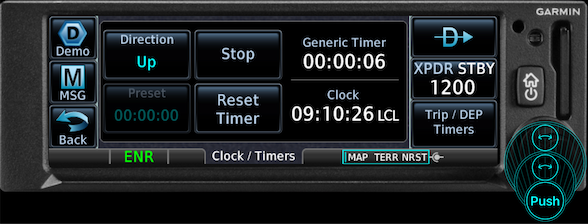
- During the pilotage portion (no Garmin GPS for navigation), the Garmin’s built-in timer is still fair game and really handy. “Reset Timer” restarts it automatically.