
How I Prepare for the Checkride Oral (What Worked for Me)
Intro
Where do I even start studying for the oral?
- That was the hardest part of my PPL. I was willing to put in the work, but I had no idea what to study, how deep to go, or how much ground to cover.
- After a lot of trial and error, I landed on a method I’ve used ever since, for my IR, CPL, and now CFI.
- Here’s the method, and how I got there.
TL;DR;
- While studying for the written, jot down anything useful from the question bank, organized by topic.
- Use your online ground school as the backbone and build your own study notes.
- This is the most time-consuming step.
- Make sure you understand each concept, then summarize and organize it.
- Fold in your notes from step 1, by topic.
- Cross-check against the ACS to make sure nothing is missing.
- Condense those notes into a cheat sheet.
- Keep it as simple as possible, mostly keywords.
- The act of condensing it is a review in itself.
- Memorize the cheat sheet.
- Practice explaining each topic out loud in English, expanding on the keywords you memorized. Watch plenty of mock oral videos too.
Why PPL Oral Prep Is Hard
When you ask for advice, you’ll usually hear something like:
- “Just study the ACS.”
- “Read the PHAK.”
- “Get the ASA Oral Exam Guide.”
- “Just memorize one of those PPL oral study guides floating around online.”
None of that is wrong. But honestly, none of it helped me much. I tried reading the PHAK from the beginning, summarized the ASA Oral Exam Guide, and downloaded every PPL oral PDF I could find and reorganized those too. I think I spent more time making study materials than actually studying. It was stressful, and I wasted a lot of time.
My Take on the Usual Resources
FAA Handbooks (PHAK, AFH, AIM)
The PHAK (Pilot’s Handbook of Aeronautical Knowledge), AFH (Airplane Flying Handbook), and AIM (Aeronautical Information Manual) are all great. The problem is that they’re massive. A lot of what’s in them is way beyond the PPL level. Topics like types of turbine engines or semimonocoque vs. monocoque fuselage design won’t come up even on the CPL oral. But if you read the PHAK cover to cover on your own, there’s no way to tell what’s important, what’s less important, and what you can skip.
“Just read the PHAK” only makes a student who’s already lost feel more lost. Read the parts you need, when you need them.
ASA Oral Exam Guide
It has a lot of good content, but it tends to be wordy. Even simple topics get long answers, so it takes a while to get through. For example:
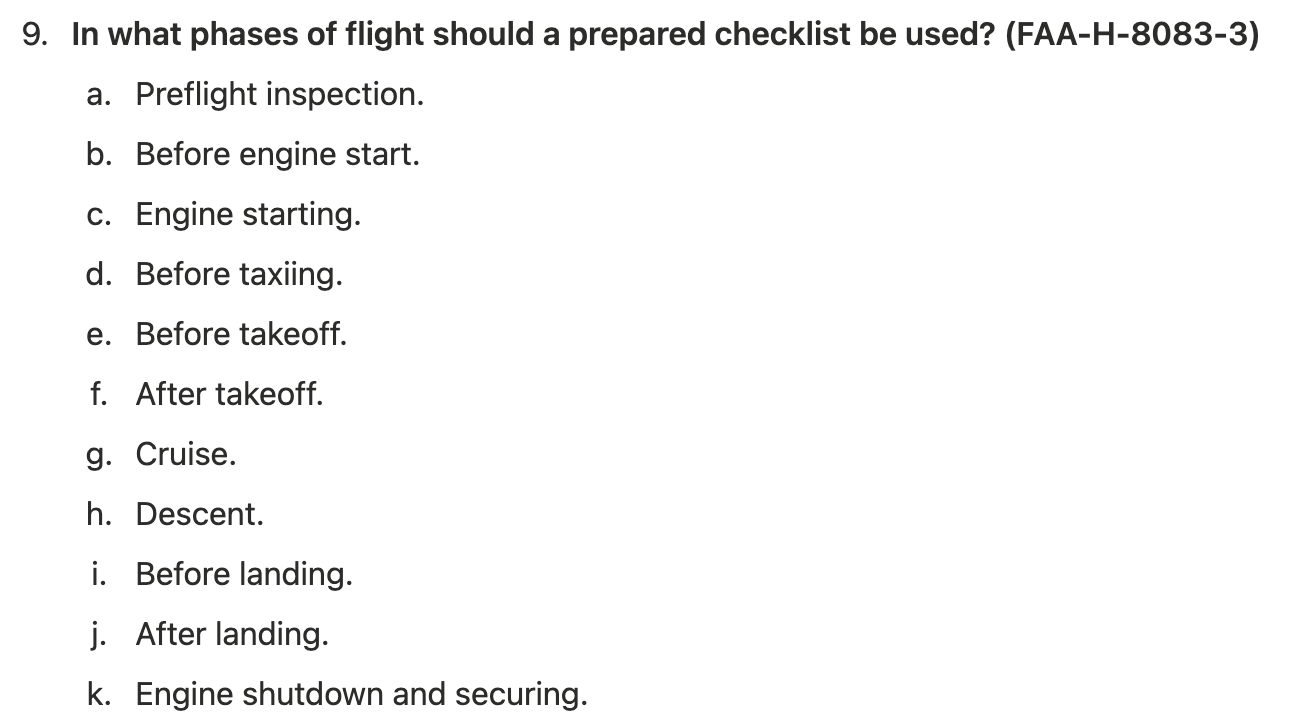
If you’re studying for your PPL for the first time, this looks like something you need to memorize word for word. But a DPE isn’t going to ask you to list these. Much of the book is written this way, so it feels like the list of things to memorize never ends. I’d save it for when you’re mostly ready for the oral and have some time to spare.
PPL Oral Study Guides Online
They’re nicely condensed. But some of the regulations in them are outdated, and a condensed version alone often isn’t enough to really understand the concept, so you end up studying it separately anyway. If all you do is memorize a study guide, you’ll get stuck the moment the DPE rephrases a question even slightly. On top of that, every guide covers a different scope, which can get confusing.
ACS
Of course you need to read the ACS. But it won’t tell you what to study, or which areas to focus on for the oral.
So, What Worked?
This is the method I’ve used since my IR, through my CPL, and now for my CFI.
1. Take Notes from the Written Question Bank
Most of us start a new rating by knocking out the written first. For the PPL, a lot of people use Gleim, and for the rest, most people use Sheppard Air. It’s tempting to just memorize the answers and move on, but there’s a lot of good material in the question bank. Here are a few from my CPL prep:
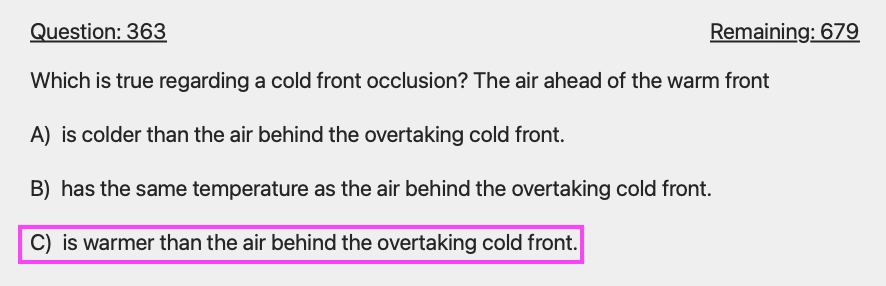
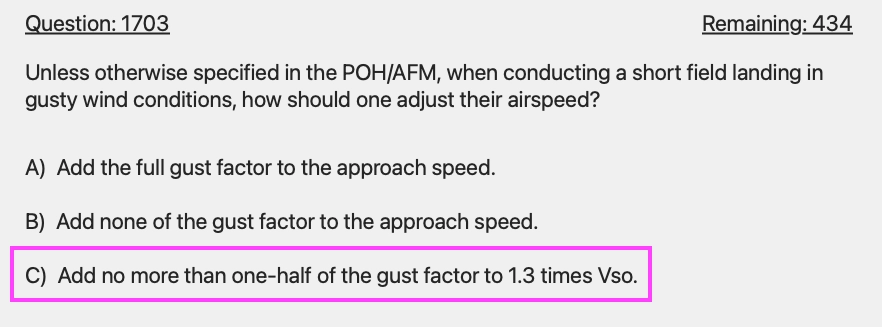
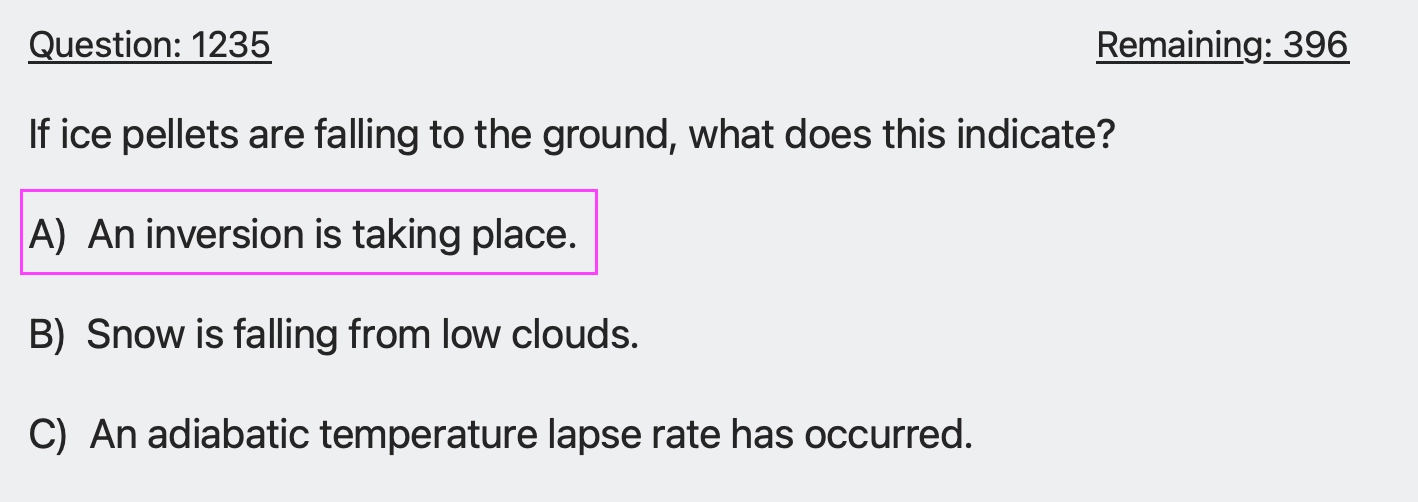
It’d be a shame to memorize answers like these and forget them after the test. Whenever one comes up, write it down by topic.
2. Build on Your Online Ground School
This step takes the most time, because this is where the real understanding happens.
Treat your online ground school like a textbook. Think about how those courses are made. I can’t say for sure, but if I were building one to sell, I would:
- Read the ACS to see what the checkride requires.
- Check the official references (PHAK, AIM, AFH) to see how much depth the FAA expects on each item.
- Condense and organize all of it.
And that’s pretty much what online ground schools are. They pull out the key parts of the PHAK, AIM, and AFH for each rating and present them in a digestible way. You paid hundreds of dollars for it. Don’t just get the endorsement and forget about it. Get your money’s worth.
Sure, the explanations are thin.
There’s a huge amount to cover, and nobody’s going to make a 300- or 500-hour online course. Squeezing it all in means cutting corners on explanations, so you’ll have to dig deeper on your own. Still, if you’re prepping for the PPL oral for the first time, I don’t think there’s a better roadmap.
Go through it lesson by lesson and write your own notes.
A single 10-minute video might take you an hour, or even a whole day. That’s fine. Don’t feel like you’re falling behind, and don’t rush to finish. When something doesn’t click:
- Look it up in the PHAK.
- Ask a few different AI tools and cross-check their answers.
- Search YouTube.
- Check aviation blogs like Boldmethod.
This is where you put in the effort to really understand each concept.
- Fold in your notes from the written (step 1).
- Once you’re done, you’ll have everything you need for the oral in one place.
- Finally, go through the ACS and check for anything your notes can’t answer. If something’s missing, fill the gap.
3. Condense Your Notes into a Cheat Sheet
- At this point, you understand the concepts, and you know exactly what to study.
- But your notes are probably still too long to review quickly over and over.
- So boil them down into a cheat sheet: as simple as possible, mostly text.
- In the process of trying to make it simpler, you end up reviewing everything without even realizing it.
Here are a couple of examples from mine. They might look like a secret code that only the author can read.
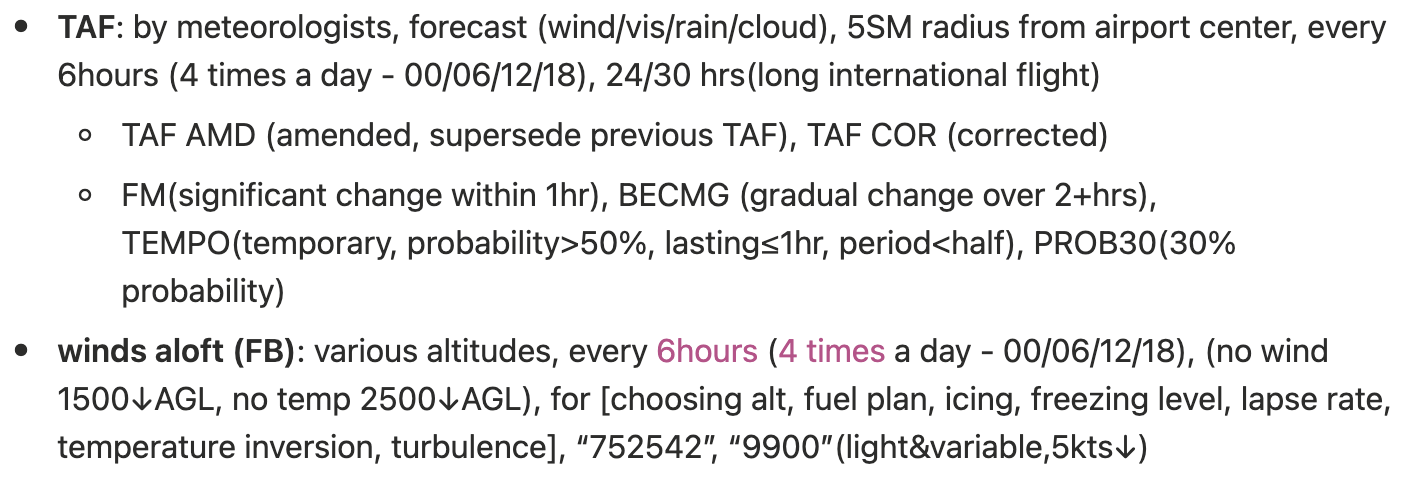
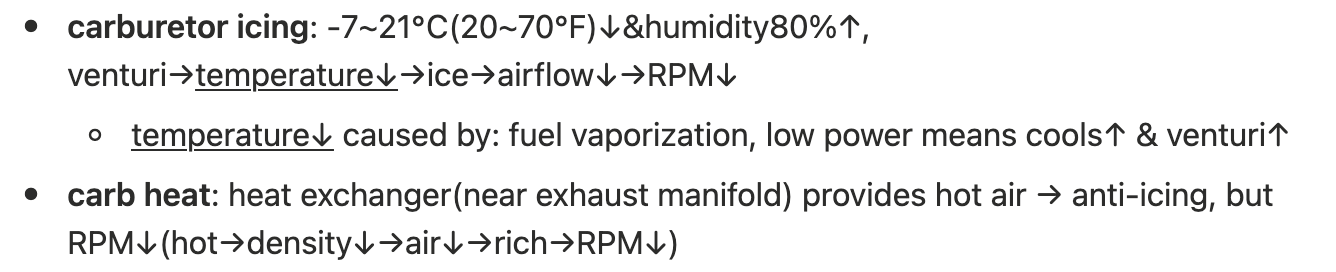
My Instrument Rating Checkride Oral Cheat Sheet is a full example of what this looks like.
4. Memorize the Cheat Sheet
- Repetition is everything.
- For the first 2–3 passes, just read through it.
- From the 4th pass on, try saying the keywords out loud from memory right after reading them.
- If you can, aim for around 7 passes.
5. Practice Explaining It in English
- Starting from the keywords you memorized, practice explaining each topic out loud in English, filling in the details.
- Watch plenty of mock oral videos on YouTube, and use them to check for anything you missed.
Final Thoughts
- I prepared for both my IR and CPL this way. I’m sharing it because I could have saved so much time if I’d known this during my PPL.
- Everyone studies differently. Take what’s useful from my experience, find what works for you, and good luck on your checkride!

