Commercial Operations: From Confusion to Clarity - Part 119 & 119.1(e)
Intro
- The topic I underestimated the most was Commercial Operations.
- I soon realized that concepts like Private vs. Common Carriage, Wet vs. Dry Leases, Holding Out, and the complex web of regulations—Part 91, 119, 119.1(e), 121, 125, and 135—are deeply interconnected and very confusing.
- I’ve put a lot of effort into unraveling these tangled concepts to truly understand how they fit together.
- In this post, I’m sharing my findings and a simplified Decision Roadmap to help fellow pilots navigate these ‘gray areas’ with clarity.
Disclaimer
⚠️ This content is for educational and informational purposes only. It does not constitute legal advice or an official FAA guideline. Always refer to the latest FAR/AIM and official regulations for actual flight operations. The author assumes no liability for errors or omissions in the content.
Opening Thoughts
- There are many ways to make money in the aviation industry. You could earn a living as a pilot, or make a profit by leasing your aircraft to others. You might even own the plane and fly it yourself for business. Another option is providing a full private jet service, where you supply both the aircraft and the pilot while managing the plane for the client.
- On the other hand, not all flights are for profit. You might fly for instruction, skydiving, or simply for fun. Some flights provide essential medical services to people in remote areas during emergencies.
- With so many different types of operations, you can’t just let everyone fly however they want. Without clear rules (even though it’s not very clear), there would be no legal standards to follow when accidents or issues occur. It’s not just about punishment; it’s about establishing safety regulations by law.
- Realistically, however, you cannot apply the same safety standards and regulations to someone flying alone for fun as you would to a private jet operator or a commercial airline carrying 300 paying passengers.
- This is why aviation law is naturally complex and, like anything made by humans, imperfect.
- Please see this writing as my own personal effort to make sense of these complicated regulations.
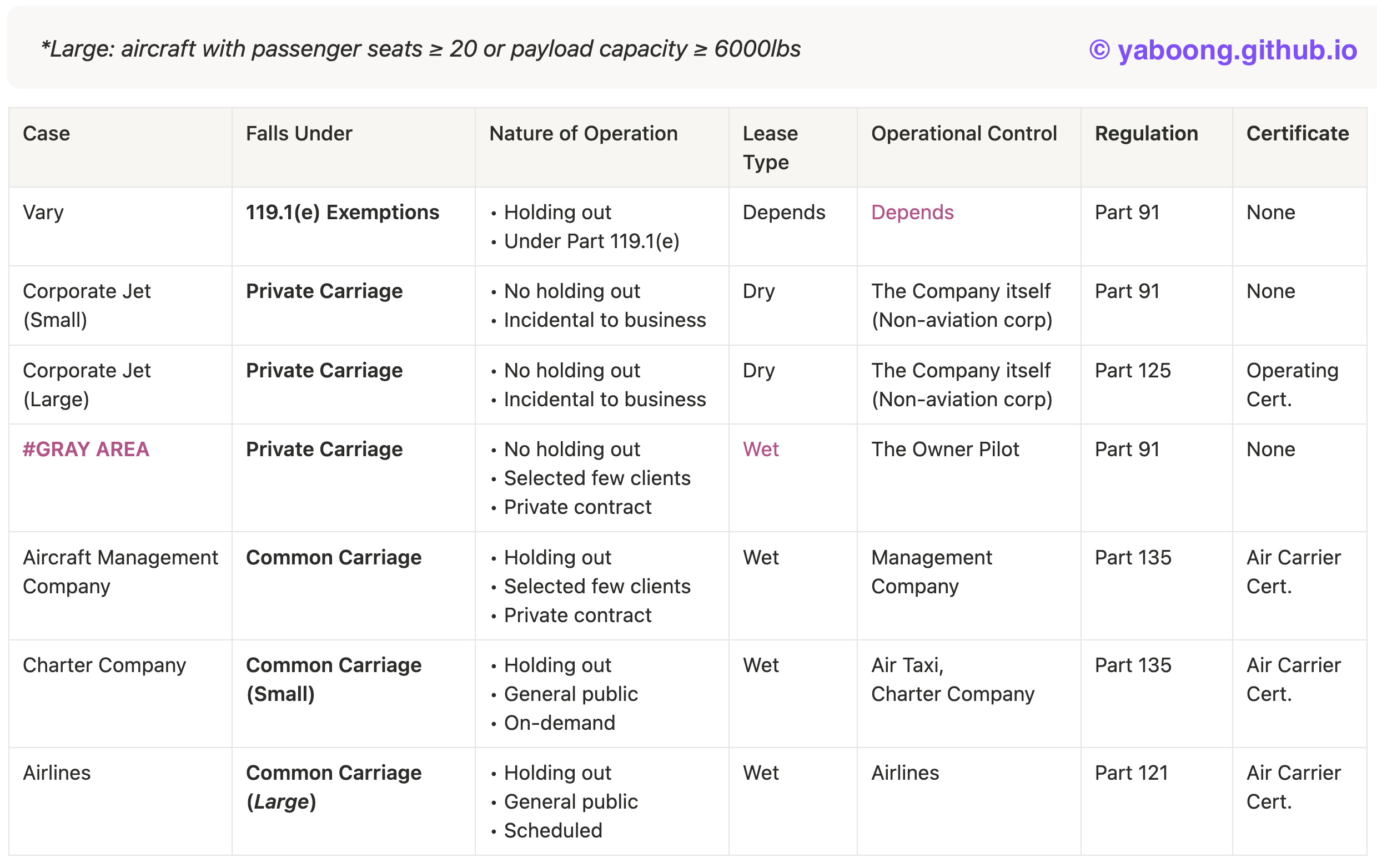
Case Table
‼️ The table below is the key takeaway from this post ‼️
(Click on the image for a larger view)
If the table below seems a bit confusing, I highly recommend reading through the Terms & Definitions and Key Takeaways first. At the end of this post, I will walk you through each case in the table step by step to make sure everything is clear.
Terms & Definitions
- Compensation: Anything of value received for acting as PIC (not limited to cash)
- Financial Gain: Direct payment (cash, salary).
- Flight Time: Building hours for free while someone else pays for the aircraft.
- Barter & Gifts: Trading services for goods (e.g., free dinner, repairs).
- Intangible Benefits: Business goodwill or professional reputation gain.
- If you are better off (financially or professionally) after the flight, the FAA considers it Compensation.
- Hire: Air transport is the main business for profit, not incidental
- Pilot for Hire: Selling labor/skills for compensation.
- Aircraft for Hire: Using the aircraft as a revenue-generating vehicle.
- Requires a 100-hour inspection (91.409b) in addition to the Annual.
- An Operator must be identified as legally responsible for the flight.
- Usually requires a Part 119 Certificate (Part 135/121) unless it falls under Part 119.1(e) exceptions.
- Holding out: An expression of willingness to the general public to provide air transportation for compensation.
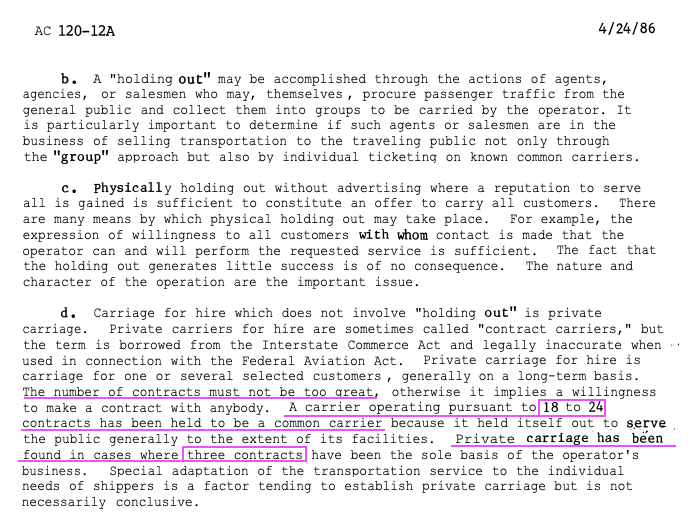
- Private carriage: Carriage for hire which does not involve “holding out” is private carriage.
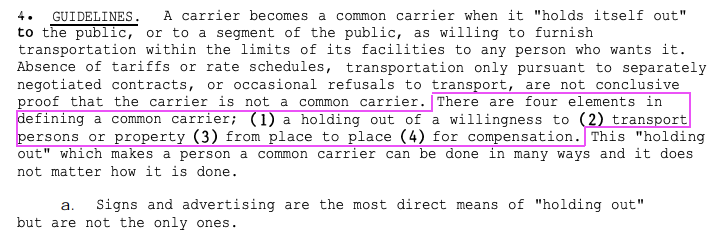
- Common carriage: (1) A holding out of a willingness to (2) transport persons or property (3) from place to place (4) for compensation.
- Operational control: The authority to initiate, conduct, and terminate a flight.
- Operator: the person or entity who is legally responsible for the safe conduct of the flight and exercises operational control.
- Dry lease: A leasing arrangement where only the aircraft is provided without a crew; the lessee has operational control and acts as the operator.
- Wet lease: A leasing arrangement where both the aircraft and at least one crew member are provided; the lessor typically retains operational control and acts as the operator.
- Air carrier certificate: A certificate required for operators conducting common carriage (e.g., Part 121 airlines or Part 135 on-demand air taxis).
- Operating certificate: a certificate required for operators conducting private carriage for compensation or hire (e.g., Part 125 or Part 135 management companies).
- 14 CFR
- part 119: Regulation that determines who must obtain a certificate and which operating rules (Part 121, 125, or 135) apply.
- part 119.1.(e): List of commercial operations (such as student instruction, crop dusting, and banner towing) that are exempt from commercial certification and allowed to operate under Part 91.
- part 91: General operating and flight rules (basic rules for all aircraft). It covers non-commercial flights, corporate private operations, and the specialized operations listed in 119.1(e).
- part 121/135: Regulations for commercial operators conducting Common or Private Carriage for compensation or hire.
- part 125: Special regulations for the private operation of large aircraft (20+ seats or 6,000 lbs+ payload) that do not involve common carriage. (→ “you’re part 91 but too big, I want to manage you more strictly”)
Key Takeaways
- Purpose of the certificate
- Purpose of the certificate is to strictly manage the operator who carries the general public or others for compensation.
- Private operation is not a commercial activity (carriage). Since the aircraft is used for own business or personal purposes, it is sufficient to just follow Part 91 flight rules without the need for a separate certificate.
- Things possible without a certificate (air carrier / operating):
- Pilot skill can be provided. Providing only pilot labor is ‘employment’, not an ‘air transportation service’. Operational control remains with the aircraft owner, not the pilot.
- Aircraft can be provided (dry lease). The lessee becomes the operator. Part (91/135/121/125) applies depends on how the lessee uses the aircraft.
- ↔ Providing both “pilot skill + aircraft together (wet lease)” → Certificate (air carrier / operating) is required.
- Carriage vs non-carriage
- The key to determining whether it is carriage or not is the lease type (dry/wet), which means “who has operational control”.
- Dry lease: The lessee has control → non-carriage (Part 91 possible).
- Wet lease: The lessor/contractor has control → carriage (Part 135/125/121).
- Private carriage vs Common carriage
- Key difference between private and common carriage is holding out.
- AC 120-12A states “(1) a holding out of a willingness to (2) transport persons or property (3) from place to place (4) for compensation.”
- Common carriage always requires an air carrier certificate.
- Part 125 is focused more on “safety management for large aircraft” rather than being a “commercial transportation business” itself.
- In the event of an accident, legal responsibility lies with the person or entity that holds operational Control.
Case Table - Break Down
‼️ The table below is the key takeaway from this post ‼️
(Click on the image for a larger view)
Based on the Definitions, and Key Takeaways we’ve covered, let’s take another look at the table below.
The main premise is this: providing just the pilot’s skills is allowed, and providing just the aircraft is allowed. However, providing both together is not possible without a certificate (either an Air Carrier or Operating Certificate).
Vary - 14 CFR 119.1(e)
- There are various cases, such as flight instruction, banner towing, aerial photography, crop dusting, sightseeing, and parachute jumping.
- For these operations, I have marked Lease Type and Operational Control as Depends.
- This is because the scenarios vary greatly: an instructor might use their own plane or one owned by a flight school; a skydiving company might provide both the aircraft and the pilot; or a farm owner might use their own plane and simply hire a pilot for crop dusting.
- Because of this wide variety, Part 119.1(e) does not specify a single standard for these cases.
- In short, if an operation falls under these exemptions, it is not restricted by the usual regulations, regardless of whether there is holding out or if the flight is for compensation or hire.
Corporate Jet (Small / Large)
- In both cases (Small and Large), the company must own the aircraft and maintain Operational Control by using a Dry Lease structure.
- A prime example is Mark Cuban, the owner of the Dallas Mavericks, who owns his own Boeing 757/767 and uses it for team operations.
- The company can either hire its own crew directly or outsource the practical management to an Aircraft Management Company.
- In the latter case, the management company only provides services like supplying pilots, purchasing fuel, and handling maintenance.
- The applicable regulations depend on the aircraft size:
- owning a Pilatus PC-12 falls under Part 91, while owning a Boeing 737 falls under Part 125.
- If the aircraft is large enough to be under Part 125, an Operating Certificate is required.
- Two Critical Points to Remember
- No “Holding Out”: It is illegal for a company to provide flight services to the general public using its private jet when it’s not in use. To earn revenue from an idle aircraft, the owner typically dry leases the plane to a company like Executive Jet Management (EJM). EJM then provides that aircraft to clients via a wet lease and shares the profit. In this scenario, the company providing the wet lease (like EJM) must hold a Part 135 Air Carrier Certificate.
- Must be “Incidental to Business”: The primary purpose of the flight must be the business itself, with the aircraft serving merely as a means of transportation for that business. For example, if a friend of the company CEO uses the jet for a vacation, it is illegal. This is because the flight is no longer incidental to business; instead, the “place-to-place transportation” has become the primary purpose of the flight.
#GRAY AREA
- This is the most controversial area and one that the FAA monitors very closely.
- The key factor here is whether the operation qualifies as “Common Carriage” as defined in AC 120-12A.
- If you are a pilot who owns an aircraft and provides transportation services via a wet lease for compensation, it can still fall under Part 91 as long as there is no holding out.
- This is possible if the customer finds you first or if the transportation stems from a very specific, pre-existing business relationship.
- A typical example would be: A CPL pilot with their own SR22 providing long-term travel services exclusively for 1–2 specific business partners under signed contracts.
- This is a case where the boundaries are not clearly defined, making it a “gray area” that is easily exploited.
- Operating under Part 135 requires much stricter and more expensive standards for pilot training, maintenance intervals, and insurance compared to Part 91. Some operators try to bypass these costs by running a Part 91-style operation while generating revenue like a Part 135 carrier.
- Regarding Private Carriage, AC 120-12A mentions that the FAA generally considers having 18 to 24 or more contracts as a sign that you have effectively opened your services to the public. On the other hand, it suggests that having up to 3 contracts is generally acceptable.
- So, what about having between 4 and 17 contracts?
- We have to accept that because laws are created by humans, they are inherently imperfect and some level of ambiguity is unavoidable.
Aircraft Management Company
- This case applies when an NBA team or a corporation wishes to operate a private jet without owning it, choosing instead to purchase transportation services from a company like EJM (Executive Jet Management).
- Since the provider supplies both the crew and the aircraft as a package (Wet Lease), receives compensation, engages in holding out, and provides place-to-place transportation, it is classified as Common Carriage. This is still true even if tickets are not sold to the general public. (Reference: AC 120-12A)
- Small Aircraft? → Part 135 applies.
- Large Aircraft? → In this case, you should not assume it falls under Part 125 just because it is a large aircraft. The purpose of Part 125 is to enforce stricter safety management on large aircraft that would otherwise be operated under Part 91. In this scenario, a Part 135 Air Carrier Certificate is required, and the operation must comply with the specific regulations for large aircraft within Part 135.
Charter Company
- An on-demand service (e.g., Tradewind Aviation) where anyone from the general public can book a seat for a weekend trip to Martha’s Vineyard.
- These companies engage in holding out by advertising their services to the public and operating based on individual customer requests.
Airline
- Large-scale carriers that operate on fixed routes and pre-determined schedules under Part 121.
- They are the most prominent example of holding out to the general public, providing scheduled transportation services to anyone willing to purchase a ticket.
Gray Area Cases (Not Mentioned in the Table)
Case 1: A corporate jet pilot flying the CEO’s family to the Bahamas
- This is not Part 91 operation because the flight is not incidental to business.
- Since the flight’s purpose is personal rather than business-related, it should technically fall under Part 135 standards.
Case 2: If ‘L’ is the lessor, ‘P’ is the pilot, and ‘C’ is the client—can ‘L’ lease the plane to ‘C’ and also recommend ‘P’?
- No. The moment the lessor recommends a pilot, the arrangement is viewed as a Wet Lease.
- This brings it into the Part 135 category, and without an Operating Certificate, it becomes an “illegal charter.”
Case 3: ‘L’ leases the plane to ‘C’ without recommending a pilot, but ‘C’ already knows ‘P’ and hires them independently.
- While the end result looks the same as the previous case, it can be operated under Part 91 because ‘L’ provided no information about ‘P’.
- There must be absolutely no professional link or connection between the aircraft provider and the pilot provider.
Case 4: Can a company provide a business jet via a wet lease but let the client keep Operational Control?
- No. It is a fundamental legal principle that the moment a Wet Lease agreement is made, Operational Control (the responsibility for flight safety) shifts to the service provider.
- Therefore, the provider must hold a Part 135 (or 121) Operating Certificate.
Case 5: Are there cases of providing a wet lease under Part 91/125 (Private Carriage) while also “holding out”?
- Legally, this cannot exist. However, companies like Executive Jet Management (EJM) appear to operate this way.
- The reason they can is that they actually hold the necessary Part 135 certificates, allowing them to legally bridge that gap.

