Low Wing Airplane Maneuver Tips - Steep Spiral
Intro
- Personally, I find the Steep Spiral to be one of the most challenging maneuvers.
- After plenty of trial and error in X-Plane, I’ve finally had a bit of a breakthrough.
- I’ve put together some insights and tips that I believe will make your training much more effective.
Disclaimer
⚠️ This is for educational and entertainment purposes only. I am not a certified flight instructor (CFI). Do not use this as a substitute for professional flight training. Always consult a CFI and follow your aircraft’s POH. I accept no liability for any actions taken based on this content.
TL;DR
Short on time? Just watch this.
- GS < 80: Use a 30° bank. (Don’t go much lower than this, or the radius gets too wide.)
- GS = 90–95: Stick to the 45° baseline.
- GS > 110: Increase to a 55° bank (But remember, never exceed 60°).
More GS, More Bank, More Back Pressure
Less GS, Less Bank, Less Back Pressure
Why the Steep Spiral is So Challenging
At first, I thought it was just a combination of Turns Around a Point and an Emergency Descent—both maneuvers I practiced during my Private Pilot training. I figured I just had to keep the wingtip on the reference point while descending rapidly, all while staying within bank and airspeed limits. It seemed simple enough in my head, but the reality was quite different.
1. How much bank is enough?
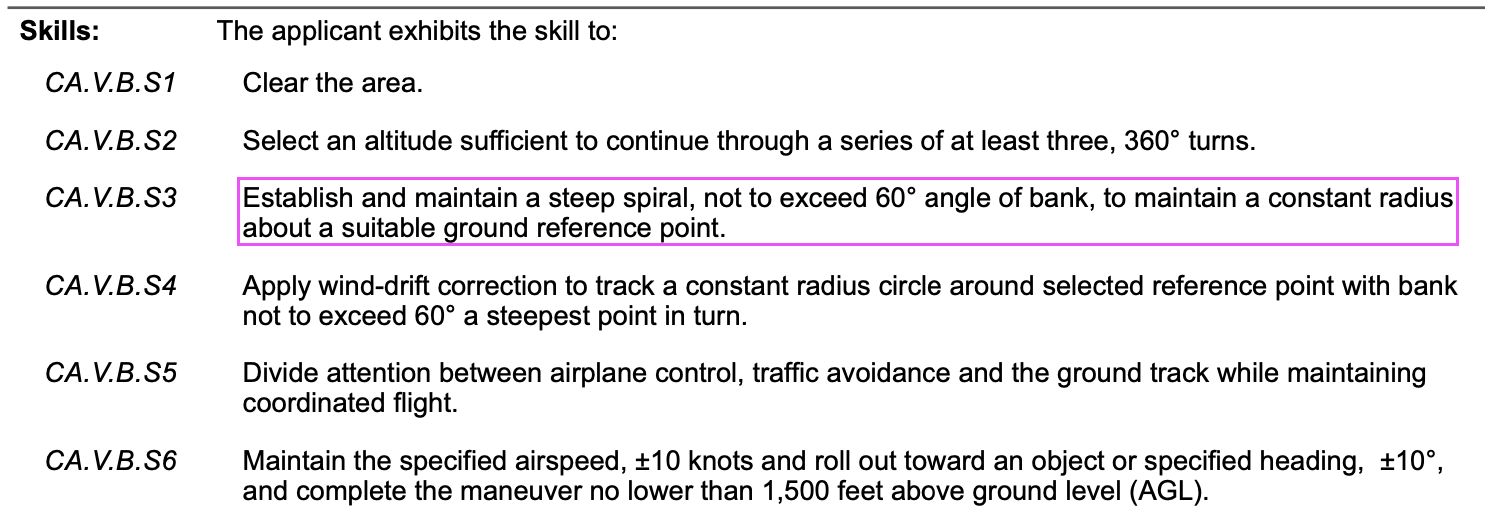
The ACS states, “Establish and maintain a steep spiral, not to exceed 60° angle of bank.” But does that mean anything under 60° is fine? Is 45° steep enough? What about 35° or 20°? The real challenge is maintaining a constant radius about a ground reference point. Finding that perfect balance between a specific bank angle and a consistent radius was personally the hardest part for me.
2. What about the airspeed?
The ACS allows a margin of ±10 knots, but ±10 knots from what exactly? Best glide speed? maneuvering speed? or just 90kts? 100kts?
3. Time and Cost
The ACS requires completing the maneuver no lower than 1,500 feet AGL, and since you have to perform three full 360-degree turns, you need plenty of altitude. Even with a conservative estimate of 1,000 feet per turn, you need to start at least at 4,500 feet AGL. My instructor prefers starting at 5,500 feet MSL (airport elevation 120ft MSL) for an extra margin of safety. Because you have to climb so high for every single attempt, this maneuver consumes significantly more time and money compared to others.
4. Different Perspectives (Left vs. Right Seat)
The view of the ground reference point is completely different for the student in the left seat and the instructor in the right. Because of these different angles, it’s hard for the instructor to give precise advice based on exactly what I’m seeing at that moment.
5. The “Low Wing” Struggle
In a low-wing aircraft, the wing often blocks the very ground reference you’re trying to follow. Maintaining visual contact throughout the entire 360-degree turn is much more difficult than it looks.
6. Coriolis Illusion
During a steady steep turn, the fluid in your inner ear stabilizes. If you suddenly move your head to check your GS on the instruments and then look back out at the reference point, it can trigger the Coriolis Illusion.
7. Constantly Shifting Winds
Not only does the wind direction relative to the nose change as you turn, but the wind speed and direction also shift as you descend to lower altitudes. You have to account for these changes constantly.
8. Everything Happens So Fast
As always in aviation, everything happens in a flash. There are so many variables changing at once that if you miss a small correction window, the whole maneuver can fall apart before you know it.
Airplane Flying Handbook
Update: This section has been updated based on feedback from a reader.
Thanks to “SeoulCitizen”! (See what’s updated: ee0d373)
Let’s look at what the FAA Airplane Flying Handbook (AFH) says about the Steep Spiral.
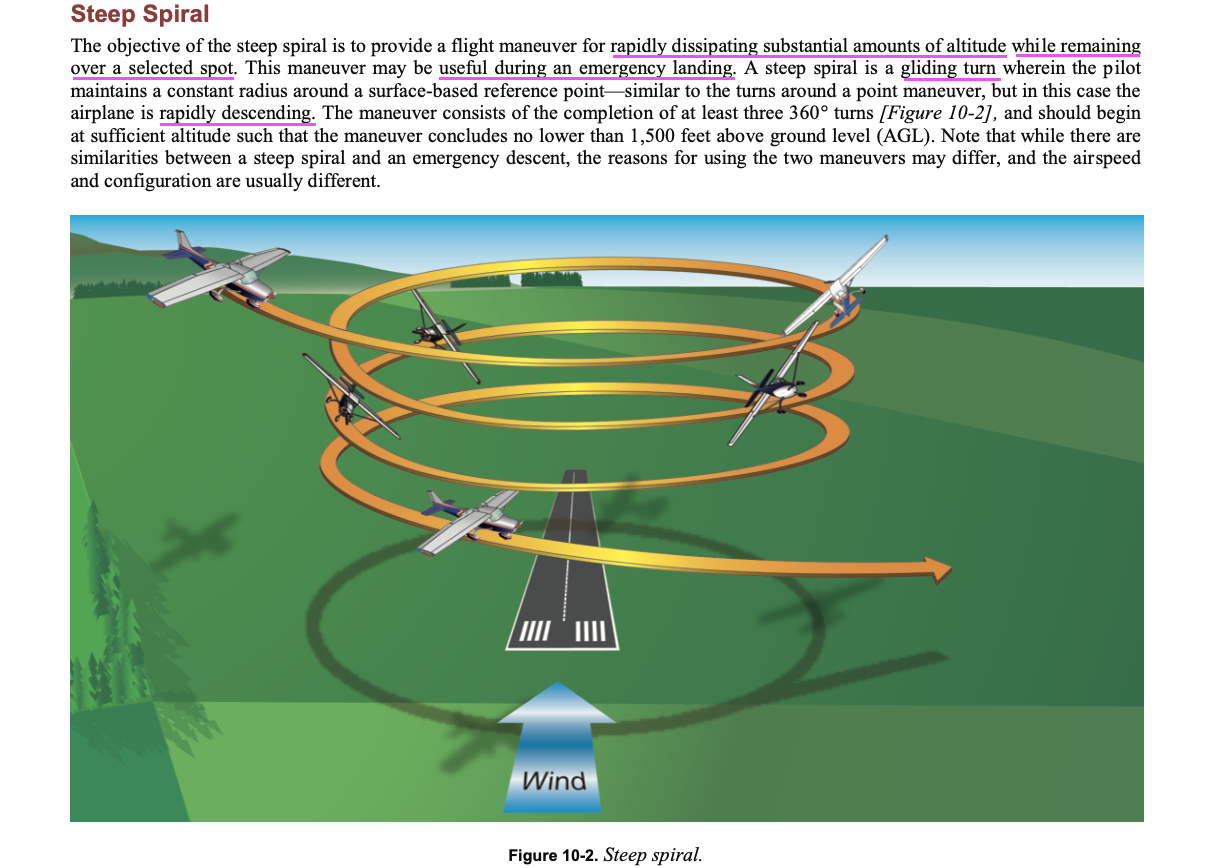
The handbook uses key phrases such as “rapidly dissipating substantial amounts of altitude”, “remaining over a selected spot”, and “useful during an emergency landing.” While these describe the maneuver’s purpose, the execution details can still feel a bit vague.
Specifically, the handbook mentions the following regarding the setup:
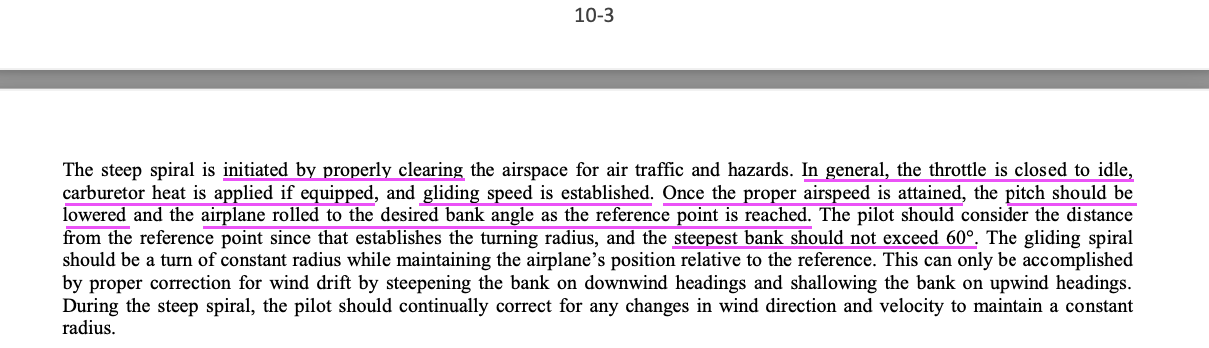
Although “gliding” is mentioned multiple times (e.g., “gliding turn” “gliding speed is established”), I don’t believe this implies the entire maneuver must be flown strictly at the best glide speed (Vg).
Since the text says “once the proper airspeed is attained, the pitch should be lowered and the airplane rolled…” after mentioning the initial glide setup, I interpret “gliding speed” as part of the initial entry procedure rather than a strict requirement to maintain that exact airspeed throughout the entire steep spiral.
How Steep is “Steep”?
How exactly do we define a “steep” turn? The Airplane Flying Handbook provides a very clear definition (thanks again to “SeoulCitizen” for pointing this out).
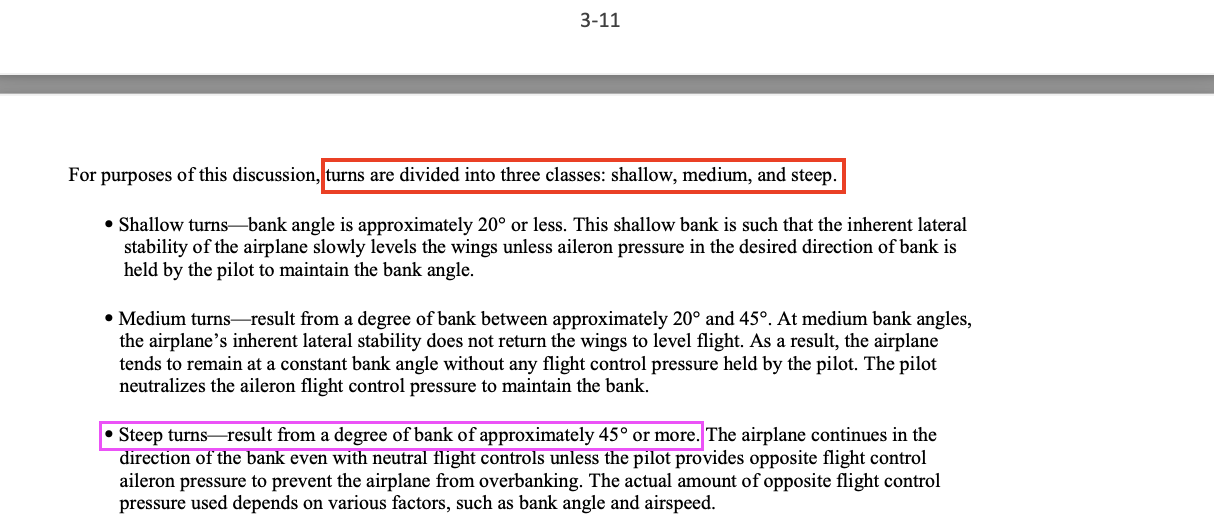
According to the AFH, “turns are divided into three classes: shallow, medium, and steep” where “Steep turns—result from a degree of bank of approximately 45° or more.” Therefore, for a maneuver to be called a Steep Spiral, it must involve a bank angle of at least approximately 45°.
So, What Are the Exact Numbers?
I’ve complained quite a bit, but that’s just because I truly believe the Steep Spiral is one of the trickiest maneuvers out there. At the end of the day, the goal is to find the “sweet spot” for bank angle and airspeed, while figuring out how to handle wind correction. I went through a lot of trial and error in X-Plane to find these numbers.
⚠️ Keep in mind, these aren’t absolute values—they will change depending on the situation.
Reasoning behind Airspeed: 90 KIAS (and why Vg might not be ideal)
While some suggest using Best Glide Speed (Vg), I found it a bit risky for this maneuver. In a PA-28-161, Vg is around 73 KIAS. However, at a 60° bank, your stall speed increases by about 41%. Vs1 for PA-28-161 is 51, and if you maintain a 60° bank while maintaining Vg (73), you’re gonna be only 1 knot above (51*1.41=72) the stall speed. That’s why I prefer 90 KIAS (within the Va range of 88-111) to Vg. And the reason why I didn’t choose 100KIAS is, 100 is too close to the maximum maneuvering speed 111, even though it depends on the weight of the aircraft. Therefore, I believe 90 KIAS is the sweet spot for a steep spiral.
- Safety: It provides a much better stall margin, especially when you’re pulling steep banks.
- Stability: The aircraft feels more stable and responsive to control inputs, even if you encounter sudden gusts.

Bank Angle Strategy: 45° as the Baseline
Through my practice, I found that 45° is a great baseline—but only if there’s no wind. To maintain a constant radius, you have to adjust based on your Ground Speed (GS):
- Approaching Tailwind: Your GS increases. You need a steeper bank here, or your turn radius will balloon out, taking you away from your reference point.
- Approaching Headwind: Your GS decreases. You need a shallower bank to prevent the circle from “pancaking” or getting too tight.
Downwind Entry - Wouldn’t Headwind be easier?
While a headwind entry might seem more “controlled” due to the slower initial ground speed (GS), it often leads to a common trap. I eventually realized that starting from the downwind (tailwind) leg is the most strategic way to stay within ACS limits.
- The Problem with Headwind Entry: Starting with a headwind requires a shallow bank initially. However, as you turn toward the tailwind side, your GS increases rapidly. If the wind is strong, you may be forced to exceed a 60° bank just to maintain a constant radius—instantly busting the ACS limit
- The Logic of Tailwind Entry: Entering downwind forces you to establish your steepest bank angle at the very beginning. By “setting the ceiling” (up to 60°) when your GS is at its peak, the rest of the maneuver becomes a matter of gradually shallowing out the bank as you turn into the wind. It eliminates the risk of needing “more bank than you have left” halfway through the turn.
The Simulation (X-Plane)
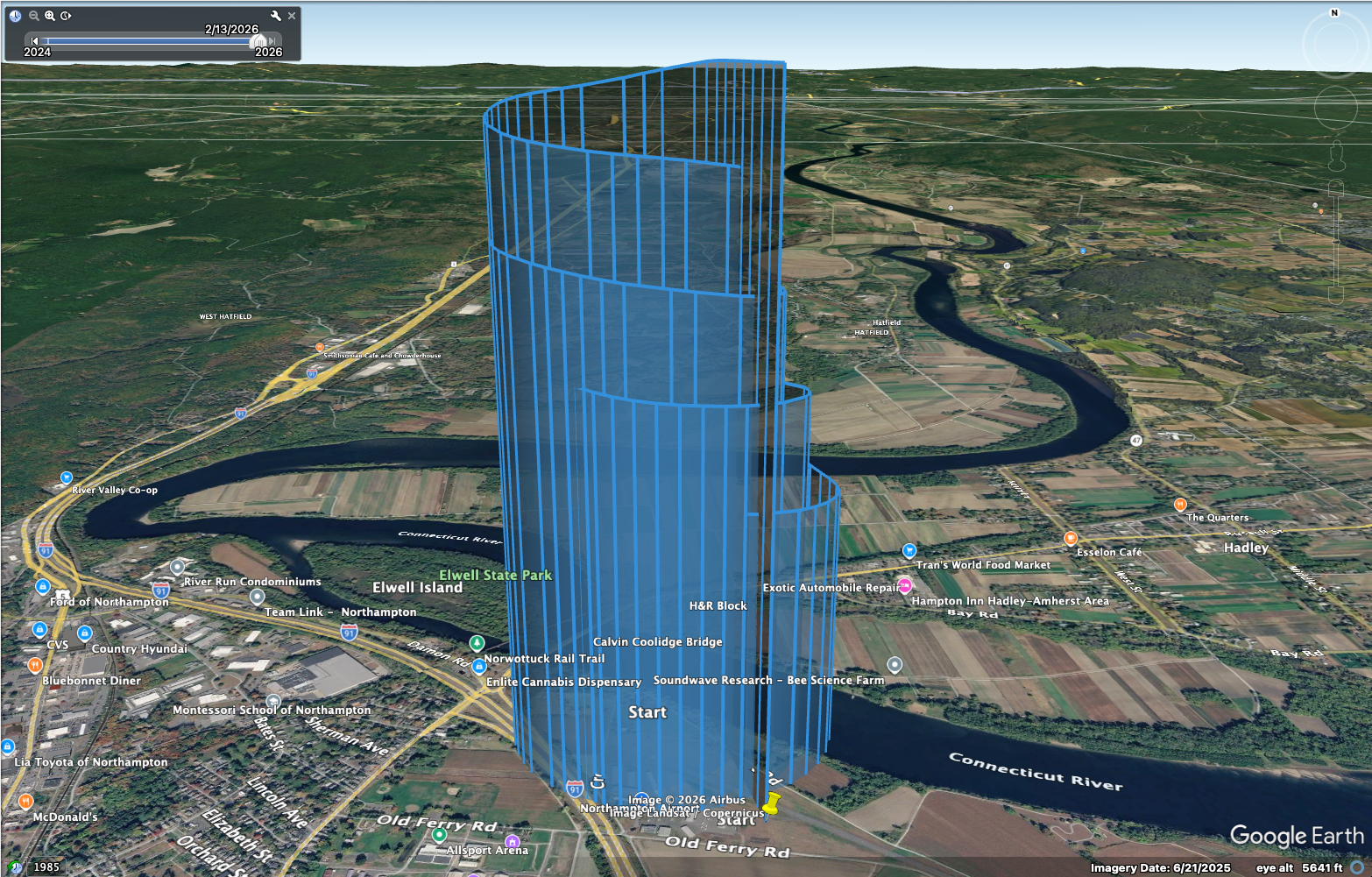
Since I can’t just go up and fly 50 times in the real world, I used X-Plane. Initially, I just wanted to see what the ground reference should look like from the cockpit, but I got a little obsessed… and here we are. In the video below, I’ll show you three scenarios:
- Wind Calm: How a constant 45° bank and 90-95 KIAS creates a perfect circle.
- Wind 180@20kts & No Correction: What happens to your circle when you hold a steady 45° bank without accounting for the wind.
- Wind 180@20kts & With Correction: My experimental results on how to achieve that “constant radius” while staying within the 60° ACS limit.
Rule of Thumb (based on GS)
- GS < 80: Use a 30° bank. (Don’t go much lower than this, or the radius gets too wide.)
- GS = 90–95: Stick to the 45° baseline.
- GS > 110: Increase to a 55° bank (But remember, never exceed 60°).
More GS, More Bank, More Back Pressure
Less GS, Less Bank, Less Back Pressure
Why Back Pressure Matters
Wait, why did I mention back pressure? It’s all about maintaining that target airspeed (90-95 KIAS) while your bank angle constantly changes.
When GS increases (Tailwind):
As you increase the bank to keep the radius constant, you lose the vertical component of lift. This causes the nose to drop, and your airspeed starts to bleed upward. To stay within the 90-95 KIAS range, you need to apply more back pressure to hold the pitch.
When GS decreases (Headwind):
As you shallow out the bank, the vertical lift increases. If you keep the same pitch, the nose will rise and your airspeed will drop. To maintain your target speed, you need to relax the elevator—less back pressure (or even a slight forward pressure)—to keep the nose down.
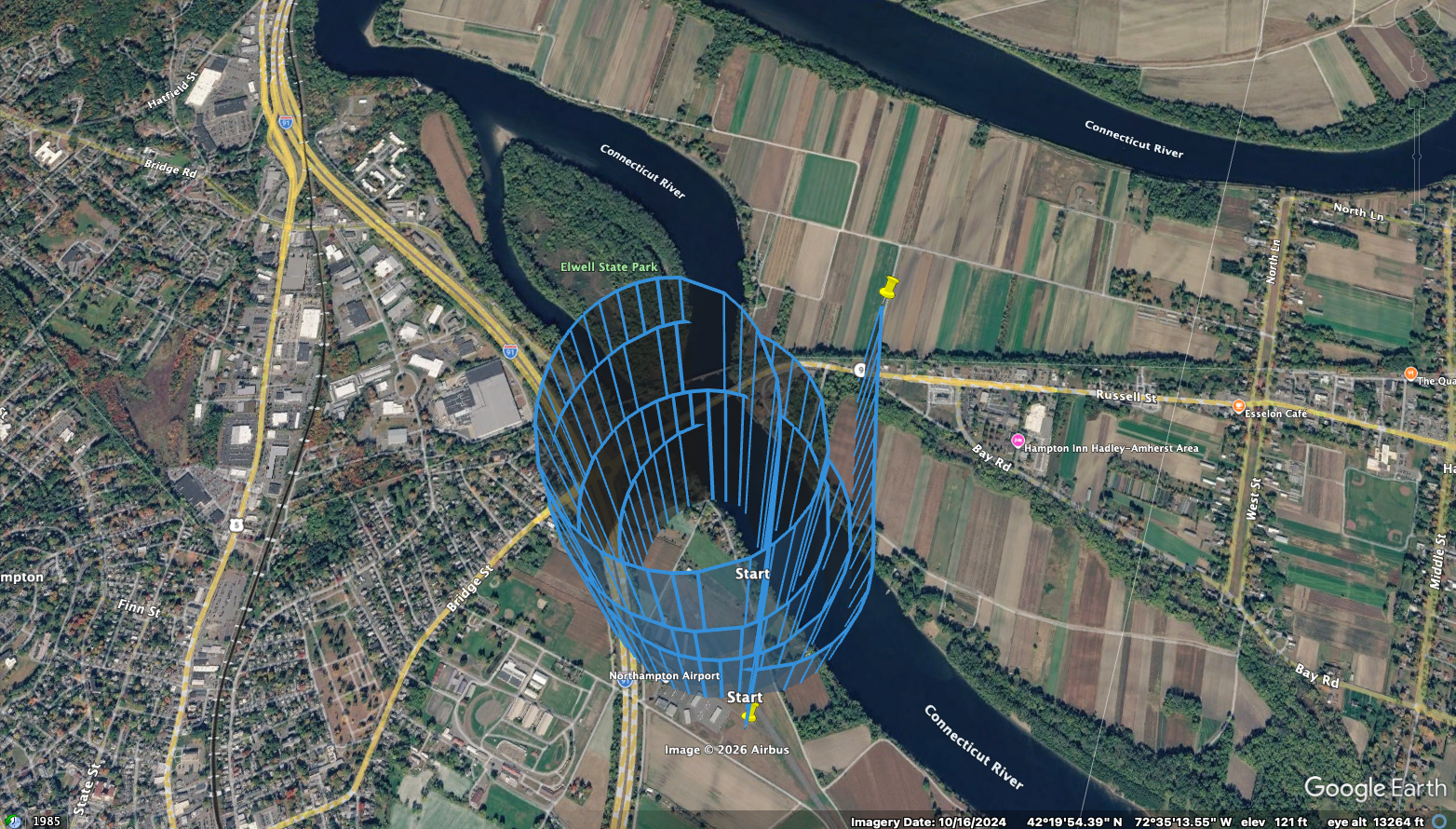
Track Log
It might not be perfect, but it gets the job done.